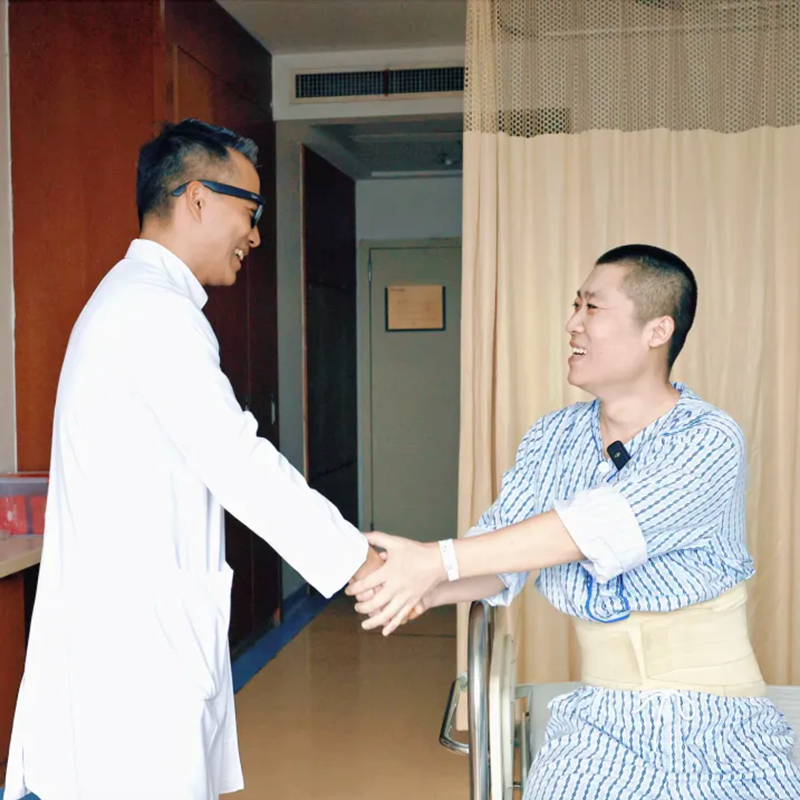
Flying 30,000 Miles for Trust: A Young Man Who Couldn’t Stand Straight Headed Straight to ZJU4H
Mr. Sun, an overseas technician working in Africa, had long suffered from severe lumbar problems due to long hours of sitting and intense work. One day, the pain became so unbearable that he could not stand or walk on his own – he had to drag himself back to his camp on a small stool, unable even to dress or use the toilet without help.
Desperate, he turned to online patient communities and came across numerous recovery stories from patients treated by Vice President Ma Jianjun and his team at the Fourth Affiliated Hospital, Zhejiang University School of Medicine (ZJU4H). Holding onto hope, he made a bold decision: fly 30,000 miles from Africa to Beijing, then transfer directly to Yiwu – a city he had never known – to seek care.
Upon arrival, Vice President Ma diagnosed him with severe lumbar disc herniation complicated by endplate inflammation – a dangerous combination that had already caused nerve damage. Because Mr. Sun had previously undergone endoscopic surgery elsewhere, this was a revision case, making traditional open surgery risky, with high trauma and slow recovery.
Instead, the team performed a customized modified two‑portal minimally invasive fusion technique – a specialty of Dr. Ma. This approach enters through natural muscle gaps, preserves spinal structures, and uses patented instruments to clearly identify scarred anatomy, greatly reducing nerve injury and recurrence risk.
The result? “On the first day after surgery, I felt my healthy waist was back – upright, pain‑free, and my legs were strong again,” said Mr. Sun. He walked easily the next day and is already looking forward to resuming his favorite hobby – running.
Dr. Ma’s team has successfully performed thousands of such procedures. He reminds that prolonged sitting, heavy labour, and poor posture are common triggers for lumbar degeneration. Early symptoms like mild backache should not be ignored; timely intervention can prevent more serious complications.
From Africa to China, across mountains and seas – Mr. Sun’s journey ended with renewed mobility and a profound trust in the care he received.