Pain is your body's way of warning you that something is wrong. If you step on a sharp object or put your hand on a hot stove, the pain lets you know right away that you are hurt and need to protect yourself. You may have pain from an injury, after surgery, or from a health problem like cancer, osteoarthritis, low back pain, headaches, or fibromyalgia.
Your body feels pain through nerves in your skin and organs. These nerve endings send pain signals to your brain.
Pain feels different for everyone. Something that doesn't bother one person might feel very bad to someone else.
Pain can feel sharp or dull. It may throb or burn. It may be in one part of your body, such as with a headache or a stomach ulcer. Or you may feel pain all over, like when your muscles ache from intense exercise or the flu.
Some pain may be so mild that you can ignore it until it goes away. But other pain may be so bad that you can't do your daily activities without medicine or other treatment.
Pain may last for a short time or a long time. It may come and go or it may be constant.
Pain that starts quickly and lasts for a short time is called acute pain. Examples include pain from an injury, a headache, childbirth, or right after surgery.
Pain that goes on for months or years is called chronic pain. You may have this pain from an injury that doesn't heal or from a health problem like low back pain, very bad headaches, or diabetic neuropathy.
Keeping your pain under control is important to your well-being. It will help you eat better, sleep better, and move around more easily. If your pain is under control, your visits with family and friends will be more enjoyable.
Some people feel that they should just put up with pain. Other people don’t want to be a bother. This is not a good idea. If you get pain relief before the pain reaches this point, it will take less medicine to make you feel better.
We want you to be as comfortable as possible. Several times each day, our staff will ask if you have pain and how bad it is. But you don’t have to wait to be asked. If you need help for pain, tell the nurse right away.
To help speed your recovery, we ask that you think about your level of pain. The doctors and nurses count on you to tell them how bad the pain is. We cannot measure pain with a test. Instead we will ask that you tell us about your pain in one of the following ways.
For other people, it is easiest to tell how bad the pain is by using a scale from 0 to 10. On this scale, 0 means no pain at all, and 10 is the worst pain possible.

With this scale, each face is for a person who feels happy because he has no pain, or sad because he has some pain or a lot of pain. Face 2 hurts just a little bit. Face 4 hurts a little bit more. Face 6 hurts even more. Face 8 hurts a whole lot. Face 10 hurts as much as you can imagine, but you don’t have to be crying to feel this bad. The doctor or nurse will ask you to choose the face that shows how you are feeling.
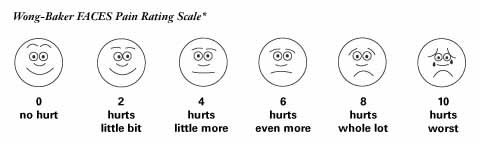
If medicine does not help your pain, or if you are having side effects, please tell your doctor or nurse. Tell us if you:
Your doctor may order medicines that can help relieve your side effects.
Pain medicines are safe and helpful when given by doctors and nurses. Some people worry that they will become addicted to the medicine they get for pain. But this almost never happens when these medicines are used for the relief of pain. Talk to your doctor or nurse if you are worried about this.
Pain or discomfort may be greater:
Take pain medicine before walking or exercising. The medicine can make that activity less painful and perhaps help speed your recovery.
Resource:
[1]UPMC lifechanging medicine. Pain Management. http://www.upmc.com/patients-visitors/education/older-adults/Pages/pain-control.aspx, 2017-1/2017-8-30.
[2] UPMC lifechanging medicine. Pain Control. http://www.upmc.com/patients-visitors/education/older-adults/Pages/pain-control.aspx, 2001/2017-8-30.
Version: H-0405-1708-V1.0
Copyright@ 2018. 版权所有 浙江大学医学院附属第四医院
 微信订阅号
微信订阅号
 微信服务号
微信服务号
 人民号
人民号
 视频号
视频号
 新浪微博
新浪微博
 抖音
抖音